How to visit, and what it means
Shoes on the Danube: How to Visit
Where the Shoes on the Danube are, what the sixty iron pairs commemorate, how to visit with respect, and how a visit fits around an evening on the river.
Check dates and availability ↗Quick answer
The Shoes on the Danube Bank is a memorial of sixty pairs of iron shoes on the Pest embankment of the Danube, south of the Hungarian Parliament. It honours the Jews shot into the river by Arrow Cross militiamen in 1944 and 1945. It stands outdoors, at the water's edge. Visit quietly, do not step into or move the shoes, and read the plaques, which are in Hungarian, English and Hebrew.
What the memorial is
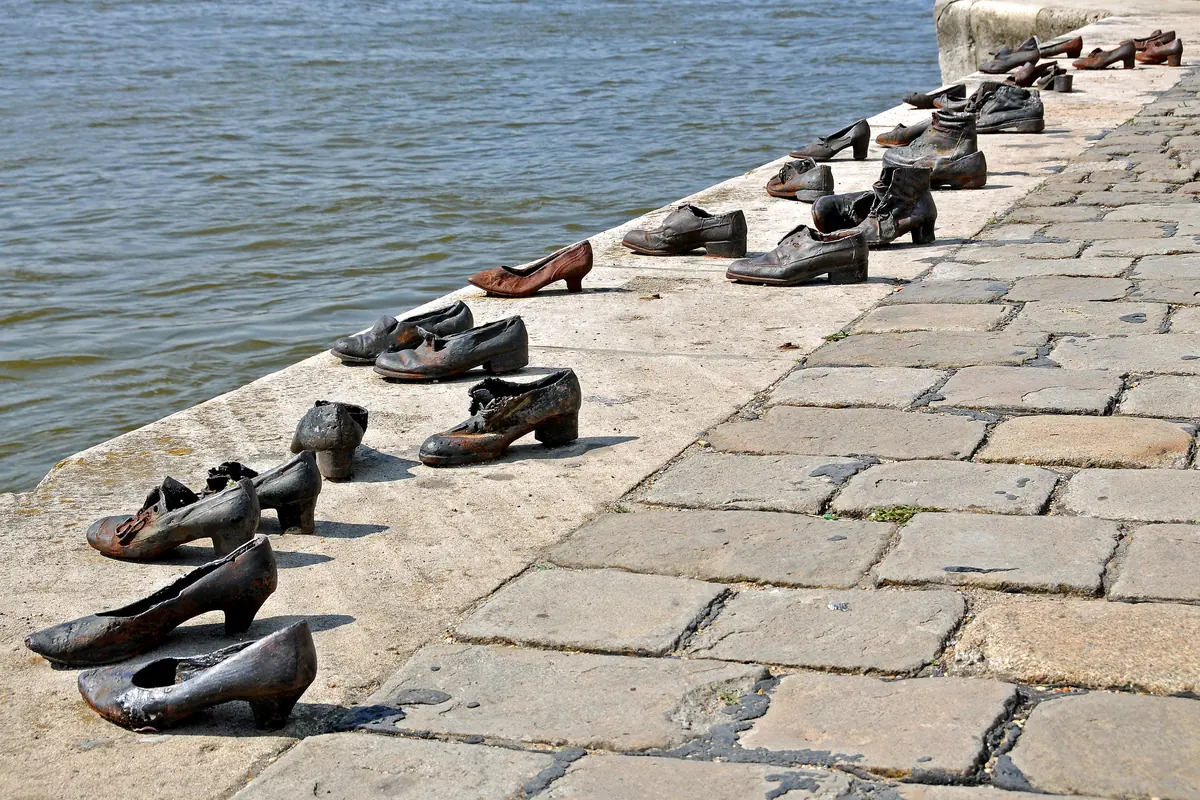
It is a row of sixty pairs of period shoes, cast in iron and fixed to the stone edge of the embankment. There are men's, women's and children's shoes, and they look as if their owners had just stepped out of them. Behind them runs a stone bench about 40 metres long. Cast-iron plaques at three points carry the same dedication in Hungarian, English and Hebrew, to the victims shot into the Danube by Arrow Cross militiamen in 1944 and 1945. It is a memorial, not a viewpoint or a photo stop.
Where it is and how to find it
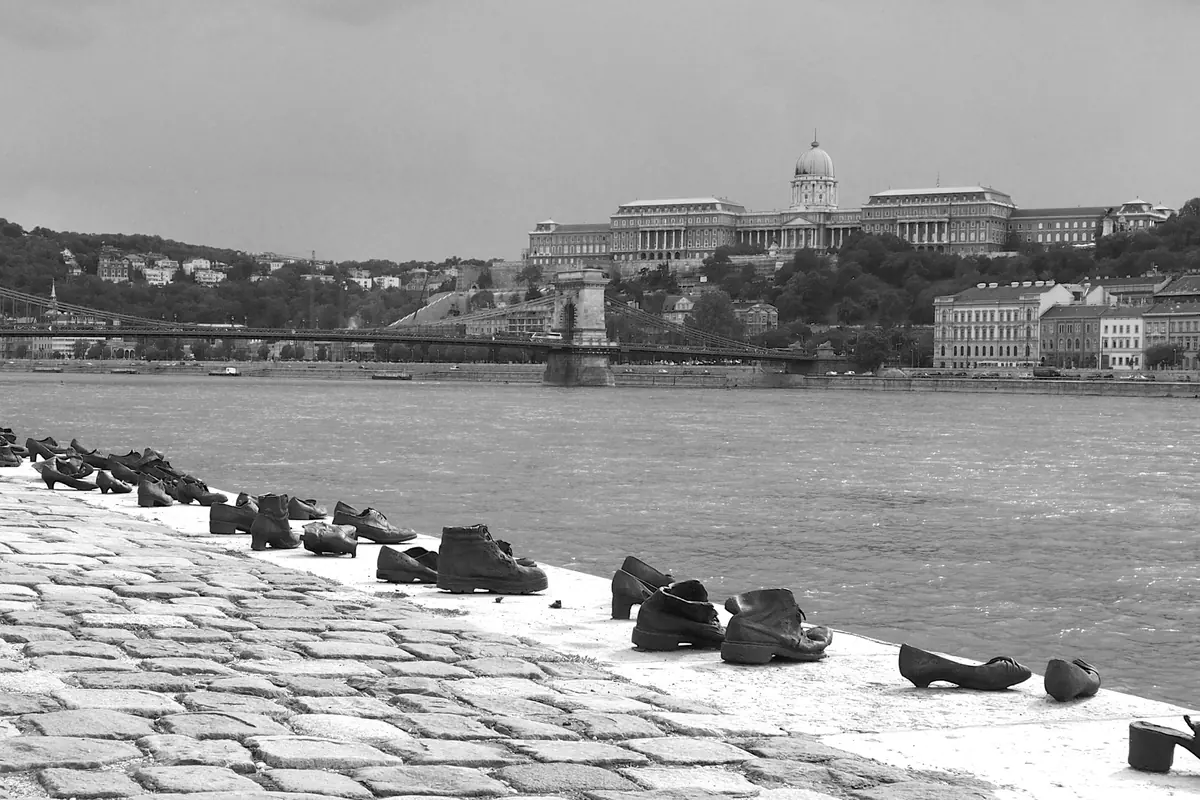
The memorial is on the Pest side of the river, on the embankment south of the Hungarian Parliament and near the Hungarian Academy of Sciences, which stands next to the Chain Bridge. Budapest's official tourism site gives the street as Id. Antall József rakpart. It lies at the water's edge, so look for the row of shoes along the embankment wall rather than for a building. There is no building to enter, because the memorial is outdoors on the embankment itself.
The history behind it
In autumn 1944 the Germans toppled the government of Miklós Horthy, and Ferenc Szálasi's Arrow Cross Party, which was fascist and violently antisemitic, took power in Budapest. That winter its militiamen killed Jews in the streets. Some groups were taken to the riverbank and shot into the Danube, which carried the bodies away. Victims were often ordered to take off their shoes first, because shoes were valuable in wartime. Most of these killings took place around December 1944 and January 1945. Soviet forces took Budapest in February 1945. Sources give different totals for the number killed along the river, so treat any single figure with care.
Who made it, and why shoes
The film director Can Togay conceived the memorial and created it with the sculptor Gyula Pauer. It was erected on 16 April 2005. The choice of shoes follows the history: they are what the victims left on the bank. The Yad Vashem article on the memorial says that empty shoes make visitors ask whose they were and who is missing. Budapest's tourism site notes that visitors and passers-by often leave candles and stones among the shoes. The plaques themselves carry only a short dedication.
What you actually see
Look closely and no two shoes are alike. Yad Vashem describes worn-down heels, shabby uppers, laced shoes and open straps, women's pumps, workmen's boots, and the small shoes of children. Some stand upright and others lie on their sides, as if they were taken off in a hurry. They are rusted iron, set into the stone, and they sit right at the edge of the water. The shoes point towards the Danube, according to the Budapest tourism site, so the river is part of the picture.
How to visit with respect
Treat the shoes as a grave marker, because for many visitors that is what they are. The memorial has been damaged before: several shoes were reported stolen in 2014, and in 2023 a tourist who stepped into the shoes to pose for a photograph was reported as having desecrated the monument. Most visitors simply stand for a while in silence. A few simple habits keep the place as it should be.
- Keep your voice low and your group small
- Do not step into, sit on, move or take shoes
- Photograph from a distance and do not pose among the shoes
- Leave a stone or a candle only if you wish, beside the shoes and not inside them
Fitting it around the dinner cruise
The dinner cruise boards at a dock on the Pest bank between the Chain Bridge and the Parliament. The memorial lies on the same stretch of the Pest embankment, south of the Parliament. The sights named for the cruise are the Parliament, the Chain Bridge, Buda Castle and Fisherman's Bastion, and the memorial is not among them. The shoes are small and sit at the water's edge, so do not count on spotting them from a boat. Visit on foot, in daylight if you can, so that you can read the plaques. That way the evening on the water and the memorial each get your full attention.
Read next: Buda and Pest: Which Side Is Which?
Children, and what to say
The history is violent, so decide what is right for your children before you arrive. For younger children, plain words are enough: these shoes remember people who were killed here, and they are not toys. Older children can be told what the Arrow Cross did and why the shoes were left behind. Tell them in advance that the place is quiet and that the shoes are not to be touched. If a child asks a hard question, it is fine to say that you will look it up together afterwards.
Where to learn more
The plaques give a dedication, not the story. The Yad Vashem article is a good short account of what happened and of the memorial. Budapest's official tourism site lists the city's Jewish memorial sites, among them the Holocaust Memorial Centre, whose permanent exhibition presents the history of the Holocaust in Hungary. It also lists the House of Terror Museum, in the building on Andrássy Avenue where the Arrow Cross was based in the winter of 1944. A visit to the shoes works best as the start of that reading, not the end of it.
Who this isn't for
If you want a backdrop for a cheerful photograph, this is not the place, and stepping into the shoes to pose has been reported as desecration. If you want a guided explanation, the plaques will not give you one, so a museum or a guided walk suits you better. If you are travelling with a very young child who cannot be quiet, you may prefer to come alone for a few minutes. And if you want a lively riverside stroll, walk further along the promenade and return another time.
Frequently asked questions
Where are the Shoes on the Danube?
On the Pest bank of the Danube, south of the Hungarian Parliament and near the Hungarian Academy of Sciences. The official tourism site gives the street as Id. Antall József rakpart.
How many shoes are there?
Sixty pairs, cast in iron: men's, women's and children's. They are fixed to the stone edge of the embankment, with a stone bench behind them.
Who made the Shoes on the Danube?
Film director Can Togay conceived it and created it with the sculptor Gyula Pauer. The memorial was erected on 16 April 2005.
What do the shoes represent?
They stand for the Jews shot into the Danube by Arrow Cross militiamen in 1944 and 1945. Victims were often ordered to take off their shoes first, because shoes were valuable.
Can I touch or step into the shoes?
No. Treat them as a grave marker, not a photo prop. In 2023 a tourist who stepped into the shoes to pose was reported as having desecrated the monument.
Can I see the memorial from the dinner cruise?
Do not count on it. The sights named for the cruise are the Parliament, the Chain Bridge, Buda Castle and Fisherman's Bastion. The shoes sit at the water's edge on the embankment, so visit them on foot.
Sources